Remix for Free

Details
FUTURISTIC PRAGUE
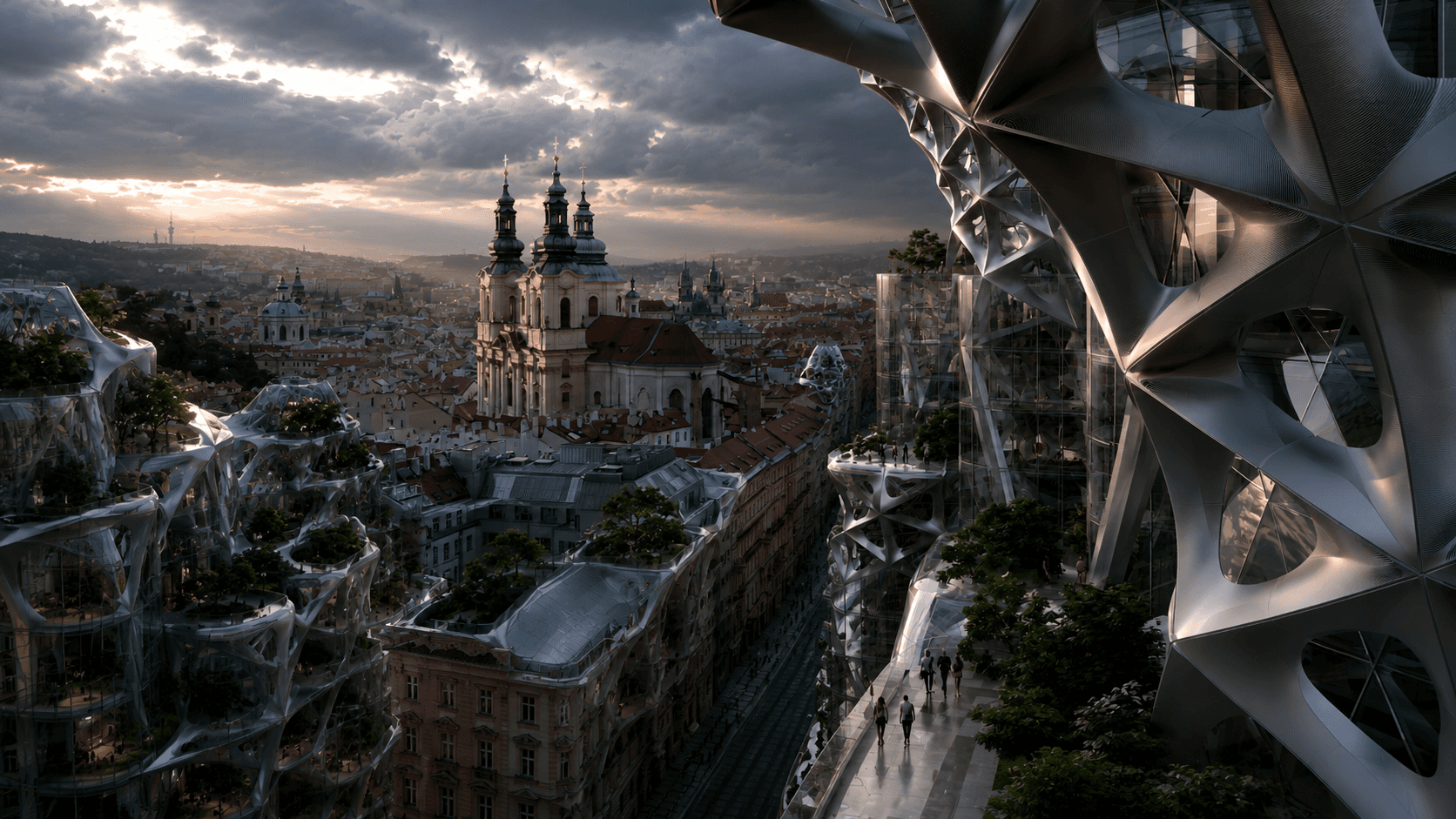
FUTURISTIC PRAGUE/THE FURURE OF GREEN BALCONIES What if every balcony became part of the city's ecosystem? In this speculative vision of Futuristic Prague, architecture is no longer separated from nature. Vertical terraces, sky gardens, and planted balconies become living infrastructure that improves urban life while respecting the historic character of the city. Green balconies are more than aesthetic elements. They help cool buildings during increasingly hot summers, capture rainwater, improve air quality, reduce noise, and create habitats for birds and pollinators. Instead of isolated planters, they form a continuous ecological network extending across the city skyline. The contrast between Prague's centuries-old architecture and fluid AI-generated structures raises an important question: Can future cities grow like forests rather than machines? Artificial intelligence allows us to explore new architectural possibilities where technology and nature evolve together, creating cities that are healthier, more resilient, and more connected to the environment. This project is not a prediction. It is an invitation to imagine a future where every balcony contributes to a greener urban landscape. SKY TERRACES ABOVE THE HISTORIC CITY IN PRAGUE What if Prague's rooftops became the city's newest public spaces? These speculative AI visions imagine a future where architecture expands into the sky instead of consuming more land. Flowing terraces weave through the urban fabric, creating elevated promenades, observation decks, and places for everyday life above one of Europe's most historic cities. The smooth, sculptural forms are intentionally quiet. Without decorative gardens, the architecture itself becomes the landscape—shaped by light, shadow, movement, and panoramic views of Prague. The terraces invite people to slow down, walk, meet, and experience the city from an entirely new perspective. Rather than replacing Prague's identity, the proposal celebrates it. Historic landmarks remain the protagonists, while contemporary architecture respectfully frames them, creating a dialogue between centuries of history and a possible future. Artificial intelligence allows us to explore these alternative urban scenarios—not as predictions, but as questions. How can future architecture enrich historic cities while preserving their unique character?
Year
2026